
25 Years Later, Landmark Purina Life Span Study Still Shapes Healthy Weight Conversations for Dogs
ST. LOUIS, Oct. 12, 2026
Press Release Disclaimer: This is a press release distributed through the XPR Media network. It has not been independently verified by our newsroom.

25 Years Later, Landmark Purina Life Span Study Still Shapes Healthy Weight Conversations for Dogs
PR Newswire
ST. LOUIS, Oct. 12, 2026
ST. LOUIS, Oct. 12, 2026 /PRNewswire/ — To mark the 25th anniversary of the groundbreaking Purina Life Span Study, which directly connected the importance of lean body condition with an extended life span, the Purina Institute reflects on findings that continue to shape how veterinary professionals think about healthy weight and longevity in dogs.
The 14-year Purina Life Span Study found that Labrador Retrievers maintained in lean body condition from puppyhood and throughout life, lived a median of 1.8 years longer than heavier matched littermates and had more years before chronic disease required treatment.1,2
The Purina Life Span Study remains one of the most influential longitudinal nutrition studies in veterinary medicine and was the first-ever canine lifelong dietary study.1,2 The study followed 48 Labrador Retrievers from seven litters throughout life. Matched littermates received the same complete and balanced diets, but one dog in each pair was fed 25% less food than its littermate to help maintain a lean body condition, while the other was fed as a control.1,2
Key findings:
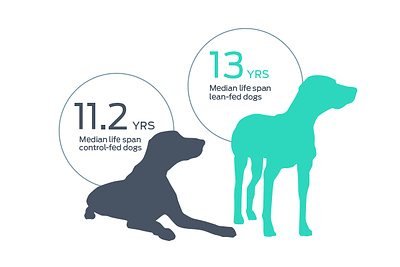
- Lean-fed dogs had a median life span of 13.0 years, compared with 11.2 years for control-fed dogs—a 1.8-year, or 15%, extension.1,2
- Lean-fed dogs reached a later age before treatment was required for age-related chronic conditions: 12.0 years compared with 9.9 years in control-fed dogs.1,2
- At 8 years of age, 10% of lean-fed dogs had osteoarthritis affecting two or three joints – hip, shoulder, elbow, or stifle – compared with 77% of control-fed dogs.2
The study is also continuing to yield new insights: Researchers have used its longitudinal data to develop and validate a biological clock and clinical markers that may help estimate biological age and predict health trajectories and mortality risk in dogs.3
“The Purina Life Span Study reflects our commitment to high-quality, long-term research,” said Brittany Vester Boler, PhD, Nestlé Purina PetCare Global Research & Development. “Its data and samples are still helping us ask – and answer – new questions about healthy aging in dogs.”
Routine body condition scoring and nutrition counseling can make healthy weight part of preventive care. Purina’s 9-point Body Condition System helps veterinary teams and pet owners assess body condition and target an ideal score of 4 to 5 for dogs.1,2
“The Purina Life Span Study has profoundly shaped how I practice and teach veterinary medicine” said Julie A. Churchill, DVM, PhD, DACVIM (SAIM and Nutrition), University of Minnesota College of Veterinary Medicine. “I integrate the findings and talk about this every day with pet owners. The message is simple but powerful: feeding pets to maintain a fit and lean condition supports longer, healthier lives.”
For more information: 14-Year Life Span Study in Dogs | Purina Institute.
Nestlé Purina PetCare Global R&D advances the science of pet nutrition through research, innovation, and collaboration to improve the health and well-being of pets worldwide.
About Purina Institute
The Purina Institute is dedicated to transforming nutrition science into actionable information that veterinary professionals can put into practice to benefit their patients. Through the Institute’s extensive online resources, publications, and scientific programs, veterinarians and team members can arm themselves with the unbiased, science-based information they need to help pets live longer, better lives.
References
1. Kealy, R. D., et al. (2002). Effects of diet restriction on life span and age-related changes in dogs. Journal of the American Veterinary Medical Association, 220(9), 1315–1320. doi.org/10.2460/javma.2002.220.1315
2. Lawler, D. F., et al. (2008). Diet restriction and ageing in the dog: Major observations over two decades. British Journal of Nutrition, 99(4), 793–805. doi.org/10.1017/S0007114507871686
3. Herzig, S., et al. (2025). A biological age based on common clinical markers predicts health trajectory and mortality risk in dogs. GeroScience, 47(1), 45–59. doi.org/10.1007/s11357-024-01352-4

 View original content to download multimedia:https://www.prnewswire.com/news-releases/25-years-later-landmark-purina-life-span-study-still-shapes-healthy-weight-conversations-for-dogs-302905985.html
SOURCE Purina Institute


