FireFox Gold Infill Drilling Continues to Build the East Zone, Including New Intercepts such as 14.1m @ 4.32 g/t Au, at Mustajärvi Project in Lapland, Finland
SODANKYLÄ, FI / ACCESS Newswire / August 25, 2026 / FireFox Gold Corp. (TSXV:FFOX)(OTCQB:FFOXF) ("FireFox" or the
Press Release Disclaimer: This is a press release distributed through the XPR Media network. It has not been independently verified by our newsroom.


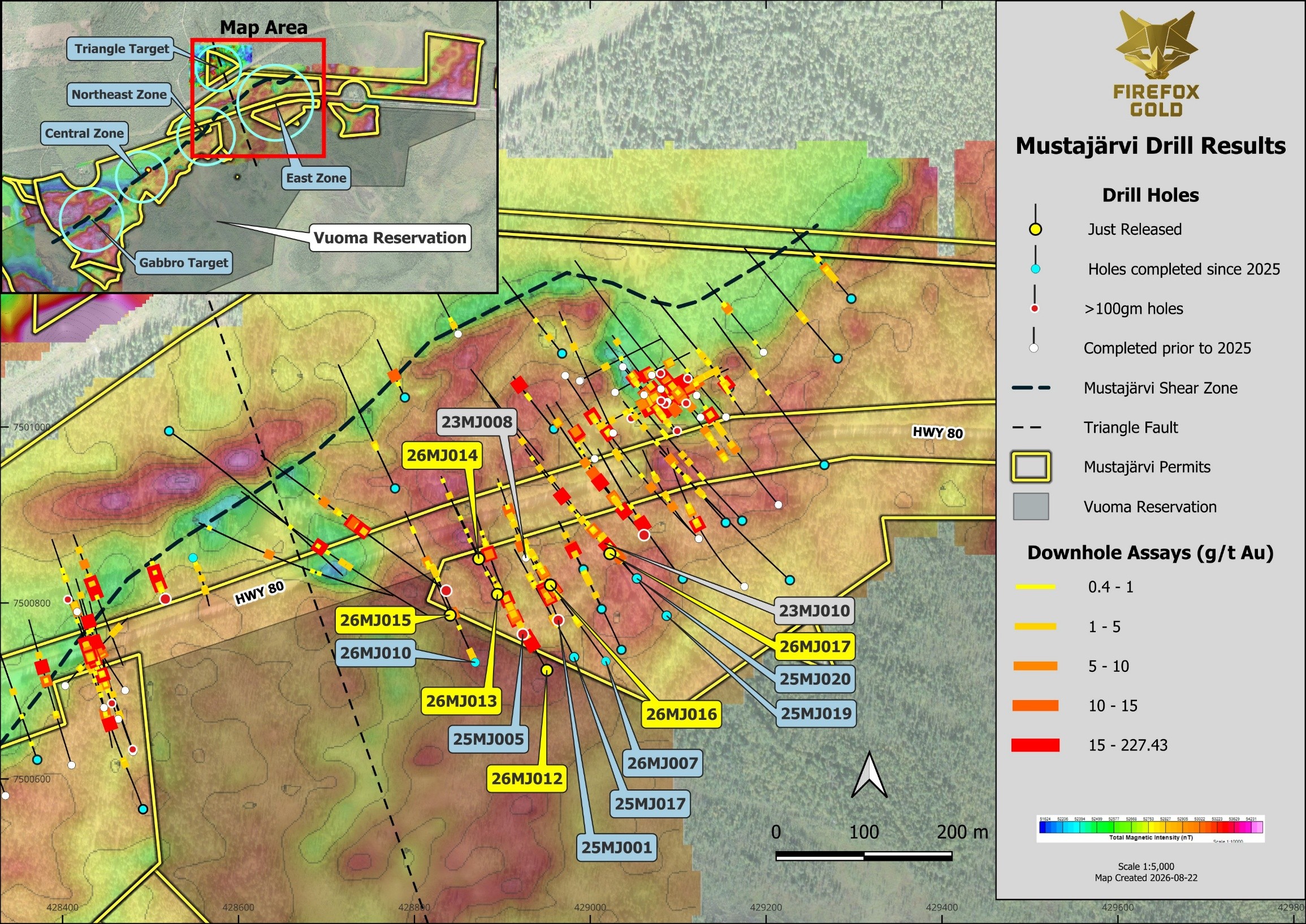
SODANKYLÄ, FI / ACCESS Newswire / August 25, 2026 / FireFox Gold Corp. (TSXV:FFOX)(OTCQB:FFOXF) (“FireFox” or the “Company”) is pleased to report assay results from six additional drill holes completed at its 100%-owned Mustajärvi Gold Project in Lapland, Finland. Holes 26MJ012 through 26MJ017 focused on further defining gold mineralization in and around the East Zone (see Figure 1).
Highlights from the new holes include:
-
26MJ016: 14.1m averaging 4.32 g/t gold from 28.0m depth, including 3.1m at 8.63 g/t gold;
-
26MJ012: 3.3m averaging 7.66 g/t gold from 80.7m depth, including 0.8m at 17.65 g/t gold, and 2.0m averaging 14.72 g/t gold from 102.0m depth, including 1.0m at 29.0 g/t gold, and 9.2m averaging 1.17 g/t gold from 109.9m depth;
-
26MJ015: 10.0m averaging 1.44 g/t gold from 126.3m depth, including 5.0m at 2.3 g/t gold; and
-
26MJ017: 1.0m at 17.65 g/t gold from 173.4 metres depth.
Carl Löfberg, FireFox’s CEO, commented, “We are very happy with these strong results from our infill and step-out program along the southwest side of the East Zone. We can see continuity of high-grade zones in the new cross sections from our modeling work, and we have many holes still to be reported from the mineral resource drilling program. In addition, we have started initial drill-testing of new targets outside of the expected resource area, and we are looking forward to reporting the first of those holes in the coming weeks. These will provide the first glimpses of our follow-up expansion targets for the post-resource programs next year.”
Mustajärvi Project and Details of Drill Results
The Mustajärvi Project lies along the highway between the cities of Kittilä and Sodankylä, approximately 17 kilometres east of Kittilä. FireFox and predecessor companies drilled approximately 15,752 metres prior to commencement of the current program; and the Company has so far delineated three different lodes of gold mineralization along more than two kilometres of strike. Inclusive of these drill holes, the total drilling on the project is now 27,355 metres.
Drill hole 26MJ012 was collared on the southern edge of the East Zone to test infill and step-out targets along strike to the west and to depth. The hole forms the southern anchor of a drill fence that also includes holes 25MJ005, 26MJ013, and 26MJ014 (see Figure 2). It was collared 68 metres west of hole 26MJ007, which was reported on August 5, 2026, and 50 metres southeast of drill hole 25MJ005. After passing through thin glacial sediments, approximately 3.7 metres, the hole intersected the contact between Savukoski group ultramafic volcanic rocks and Sodankylä group metasediments at 80.7 metres downhole.
High-grade gold mineralization starts immediately below the contact between the ultramafic rocks and metasediments, yielding 3.3 metres averaging 7.66 g/t Au from 80.7 metres, including 0.8 metres averaging 17.65 g/t Au. Gold mineralization here is associated with patchy and semi-massive pyrite overprinting brecciated quartz-carbonate-tourmaline veins hosted in strongly albite-altered metasediments. Multielement assays confirm that gold in this interval is associated with strongly elevated cobalt grades, most likely associated with pyrite, averaging 0.23% cobalt over 3.3 metres.
At 97.0 metres downhole, the drill encountered another gold-mineralized interval, returning 2.0 metres averaging 2.68 g/t Au. This was followed by a thin section of waste before passing into a zone with multiple high-grade mineralized intervals. The first of these started at 102.0 metres depth and yielded 2.0 metres averaging 14.72 g/t Au, including 1.0 metre at 29.0 g/t Au. There is a section of narrow intercalated intervals of waste and lower-grade mineralization before the drill hole cut a significant gold-mineralized interval of 9.2 metres averaging 1.17 g/t Au starting from 109.9 metres downhole, including 1.0 metre at 4.87 g/t Au from 112.0 metres depth. Gold in this part of the hole is associated with patchy pyrite and quartz-carbonate-tourmaline-pyrite (QCTP) veining hosted in strongly albite- and silica-altered metasedimentary rock.
Deeper in the hole, there are numerous narrow and lower grade intervals, most often associated with isolated veining crosscutting the albite and silicified host rocks. One notable interval is a well-developed veined and hematite-pyrite flooded zone of 4.0 metres that averages 1.19 g/t Au from 267.0 metres depth.
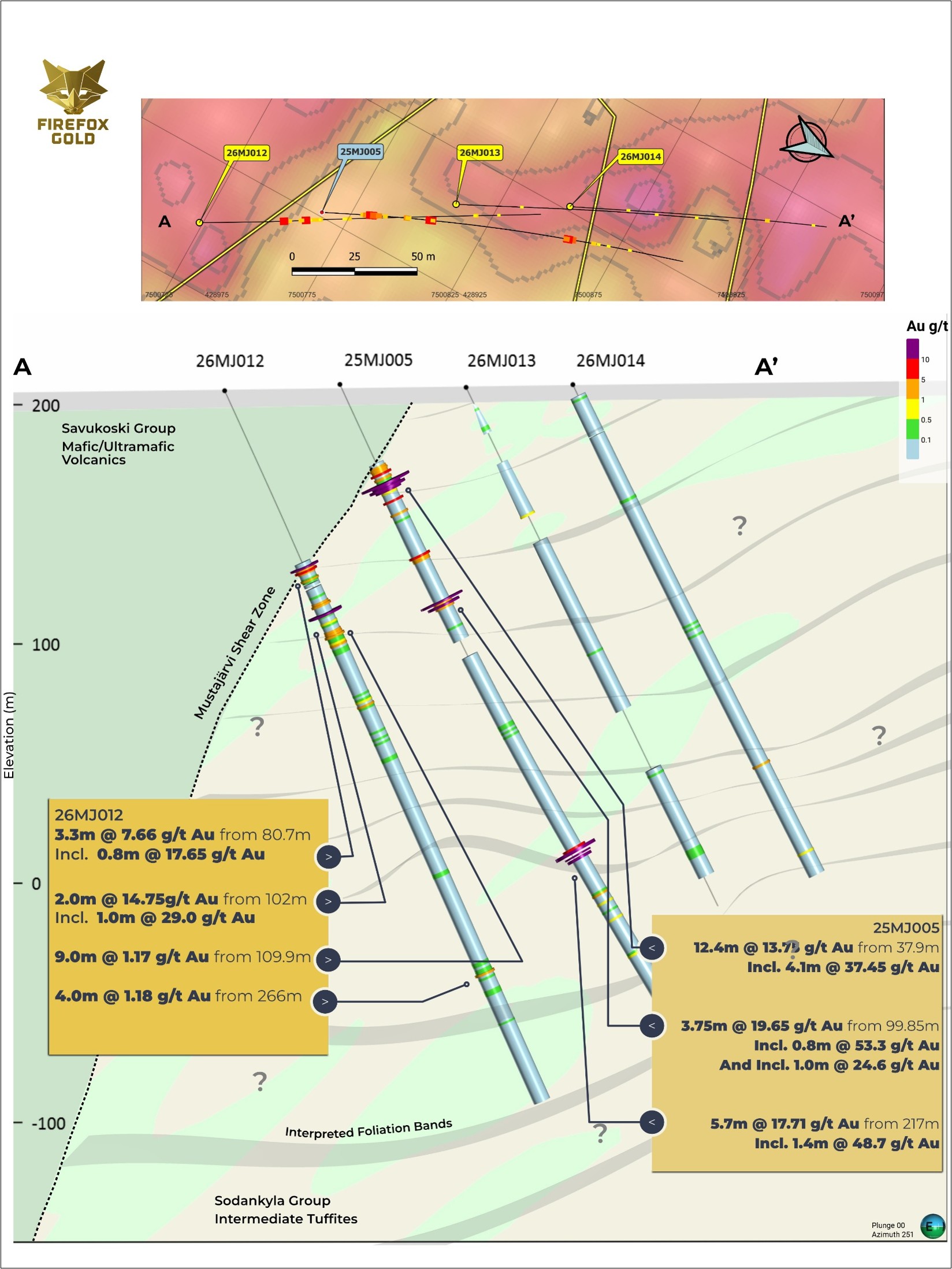
Drill hole 26MJ013 was collared 102 metres northwest of 26MJ012 as part of the same drill fence. Immediately beneath thin glacial sediments, approximately 6.2 metres deep, the hole passed into strongly oxidized, albite-altered metasedimentary rocks. The hole intercepted several narrow, lower-grade intervals associated with quartz-carbonate veining and disseminated pyrite. The first mineralized interval was cut at 59.0 metres depth and returned 1.0 metre at 0.8 g/t Au, where gold mineralization is associated with fracture-filling quartz-carbonate veinlets with disseminated pyrite hosted in brittle-fractured, strongly albite- and silica-altered metasedimentary rocks.
Deeper in the hole, a wider interval of lower-grade gold mineralization was encountered from 216.0 metres downhole, yielding 3.2 metres averaging 0.35 g/t Au. This interval is associated with the contact zone between narrow intrusive mafic rocks and altered metasediment, with anomalous gold mineralization hosted in both lithologies. Gold is associated with disseminated pyrite in quartz-carbonate veinlets. Between the two intervals described above, the hole also intersected two narrow intervals with grades up to 0.49 g/t Au.
The team collared drill hole 26MJ014 45 metres northwest of hole 26MJ013. The geology encountered in this hole is similar to that seen in 26MJ013. The hole passed into the strongly altered metasedimentary unit immediately below thin glacial sediments, approximately 5.2 metres deep, and it continued through altered metasediments regularly cut by intrusive mafic rocks. It intercepted three individual, low-grade gold-mineralized intervals associated with isolated quartz-pyrite veins starting from 52.65 metres downhole.
The best intercept was encountered at a depth of 177.0 metres and returned 1.0 metre at 2.03 g/t Au, where gold is associated with brecciated, strongly albite-altered intermediate tuffite with abundant QCTP veining and patchy pyrite.
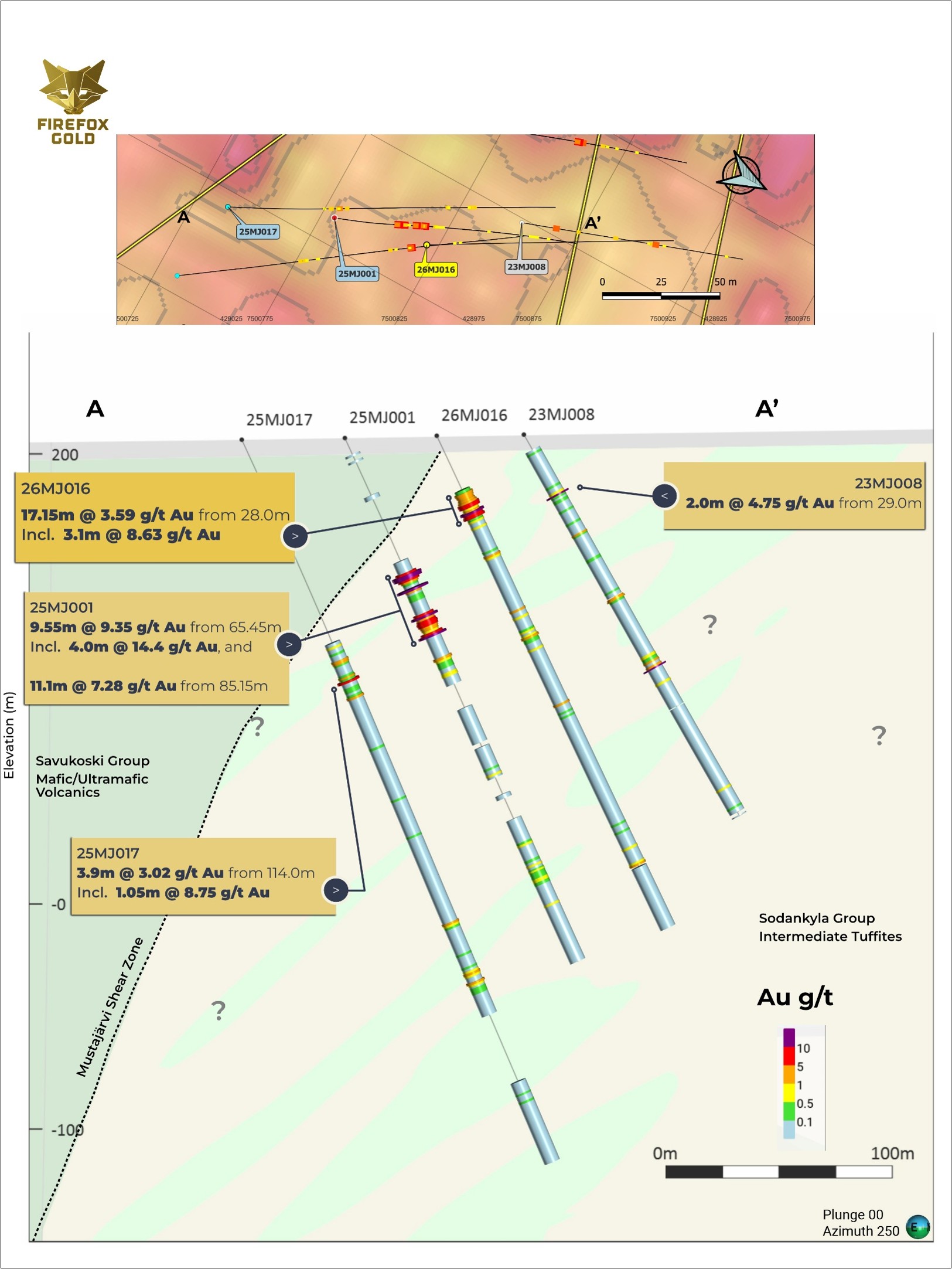
Drill hole 26MJ016 was designed as a resource infill hole in the middle of the drill fence that includes holes 25MJ001, 25MJ017, and 23MJ008 (see Figure 3). The hole was collared approximately 42 metres southeast of hole 23MJ008. After passing through thin glacial sediments, approximately 8.8 metres deep, the hole entered into Savukoski group ultramafic volcanic rocks and intersected the contact with brecciated and albite-altered metasediments at 27.9 metres downhole.
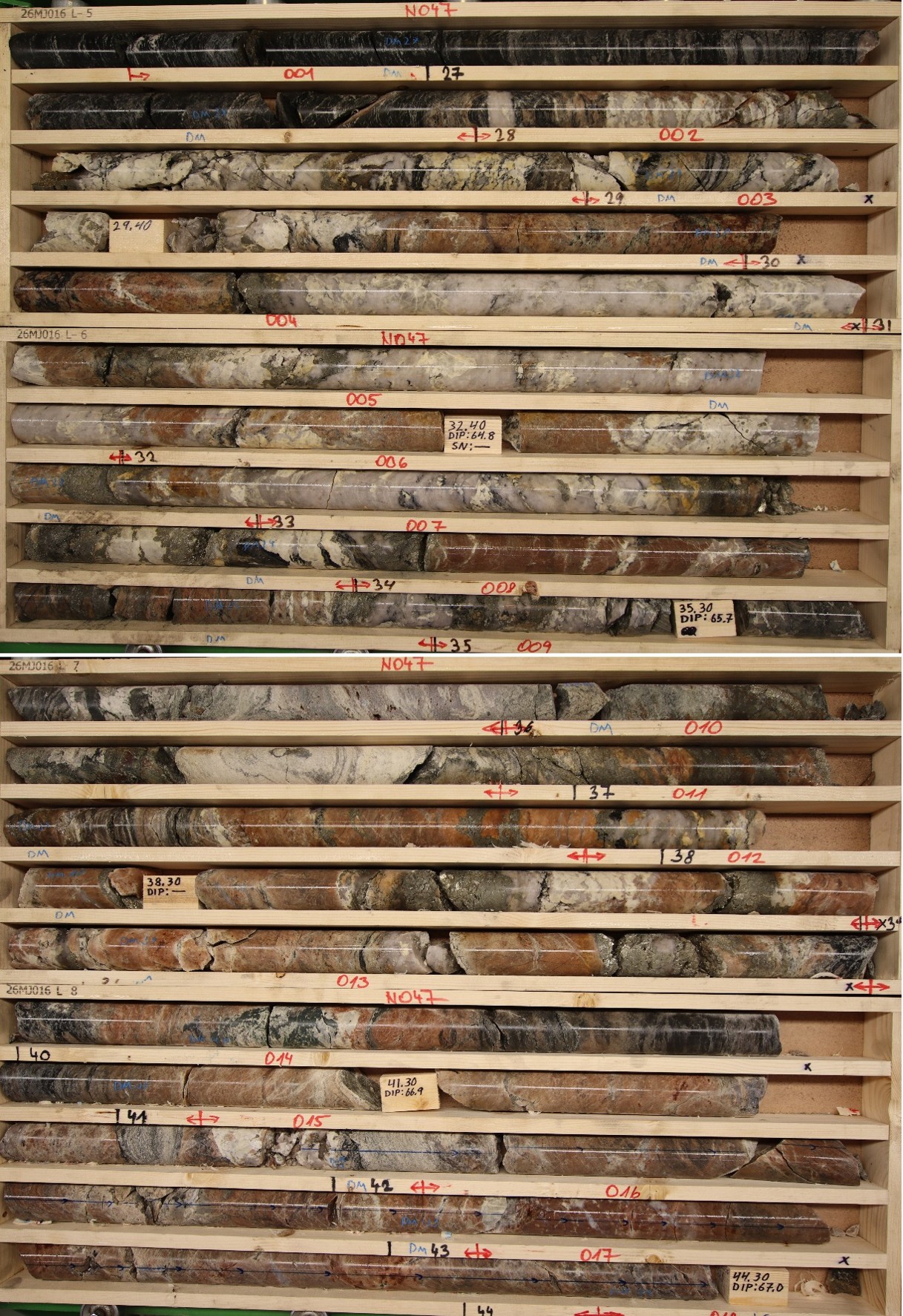
The first mineralized interval was encountered immediately below the contact and yielded 14.1 metres averaging 4.32 g/t Au from 28.0 metres downhole, including 3.1 metres averaging 8.63 g/t Au from 36.9 metres depth. Gold is associated with intense brecciation and quartz-carbonate-tourmaline veining with patchy pyrite hosted in strongly albite-altered metasedimentary rocks (Figure 4). This upper interval is within an intense deformation zone near the major contact, a setting that hosts numerous other high-grade intercepts, such as the 9.55 metres of 9.35 g/t Au reported from drill hole 25MJ001 approximately 40 metres down dip (See Company news release dated October 27, 2025).
A wider, low-grade gold-mineralized interval was encountered from 56.0 metres depth and returned 4.0 metres averaging 0.83 g/t Au, where gold is associated with quartz-carbonate veining with disseminated pyrite in strongly albite- and silica-altered metasedimentary rocks in the footwall of a mafic dike.
Deeper in the hole, the drill encountered several lower-grade intervals where gold is associated with quartz-carbonate veining, brecciation, and disseminated pyrite in altered metasedimentary rocks, notably 6.7 metres averaging 0.78 g/t Au from 94.4 metres. A further interval of 1.1 metres at 0.73 g/t Au was encountered from 201.9 metres depth, followed by a thin section of waste before the hole passed into 1.95 metres averaging 1.03 g/t Au from 209.2 metres downhole.
Drill hole 26MJ015 was designed to test the continuation of mineralization toward the west and identify the northern boundary of a mineralized structure. The hole was collared 60 metres northwest of hole 26MJ010 and 60 metres southeast of hole 26MJ013. After passing through thin glacial sediments, approximately 10.2 metres deep, the hole entered ultramafic volcanic rocks and intersected the contact with metasediments at 20.2 metres downhole. The first wider mineralized interval was encountered from 126.3 metres depth and yielded 10.0 metres averaging 1.44 g/t Au, including 5.0 metres averaging 2.3 g/t Au from 128.3 metres downhole. That interval was followed by a thin section of waste before passing into 3.0 metres yielding 2.52 g/t Au, including 1.0 metre at 6.19 g/t Au from 136.3 metres depth. Mineralization here is associated with a fault zone with intense albite-sericite alteration and crosscutting QCTP veins. Deeper in the hole, three narrower zones of low-grade gold mineralization were intercepted, with grades up to 0.98 g/t Au. In these deeper intercepts, gold is associated with strongly albite- and silica-altered metasediments with QCTP veining as infill in brittle fractures.
Drill hole 26MJ017 was designed as an additional infill hole in the fence of holes that includes 25MJ019, 25MJ020, and 23MJ010 in the southern part of the East Zone. After passing through thin glacial sediments (approximately 7.4 metres deep), the hole cut ultramafic rocks until the contact with the albite-altered metasediments at 60.3 metres depth. The first mineralized interval was encountered from 64.3 metres depth, returning 2.2 metres averaging 0.62 g/t Au, followed by 2.0 metres yielding 1.86 g/t Au from 75.0 metres downhole. Gold in these upper zones is associated with quartz and quartz-carbonate veining with disseminated and patchy pyrite hosted in strongly albite-altered metasediments.
From 100.9 metres depth, the hole encountered 3.2 metres averaging 1.79 g/t Au. Gold mineralization here is hosted in strongly albite-altered and deformed intrusive mafic rock with abundant quartz-carbonate veining and disseminated pyrite. A similar, lower-grade interval hosted in intrusive mafic rocks was encountered from 136.8 metres downhole and yielded 0.61 g/t Au over 3.3 metres.
At 173.4 metres depth, an isolated interval of quartz-carbonate veins with pyrite hosted a high-grade gold interval of 1.0 metre at 17.65 g/t Au. Similar isolated veining hosted other intercepts deeper in the hole, such as 1.0 metre at 1.61 g/t gold from 256.0 metres depth and 2.1 metres of 0.41 g/t Au from 284.1 metres downhole.
Table 1. Selected Drill Intercepts in Drill holes 26MJ012 – 26MJ017
(Cut-off Grade 0.3 g/t Au)
|
Drill Hole |
From (m) |
To (m) |
Interval (m) |
Au Grade (g/t) |
|
|
26MJ012 |
80.7 |
84 |
3.3 |
7.66 |
|
|
Including |
80.7 |
81.5 |
0.8 |
17.65 |
|
|
86.35 |
87.2 |
0.85 |
2.77 |
||
|
97.0 |
99.0 |
2.0 |
2.69 |
||
|
102.0 |
104.0 |
2.0 |
14.72 |
||
|
Including |
102.0 |
103.0 |
1.0 |
29.0 |
|
|
106.0 |
107.9 |
1.9 |
0.71 |
||
|
109.9 |
119.1 |
9.2 |
1.17 |
||
|
139.0 |
140.0 |
1.0 |
0.45 |
||
|
142.0 |
143.0 |
3.0 |
0.73 |
||
|
222.0 |
223.0 |
1.0 |
0.37 |
||
|
262.0 |
263.0 |
1.0 |
0.38 |
||
|
266.0 |
270.0 |
4.0 |
1.18 |
||
|
289.3 |
290.15 |
0.85 |
0.43 |
||
|
26MJ013 |
59.0 |
60.0 |
1.0 |
0.8 |
|
|
123.0 |
124.0 |
1.0 |
0.38 |
||
|
180.0 |
181.0 |
1.0 |
0.49 |
||
|
216.0 |
219.2 |
3.2 |
0.35 |
||
|
26MJ014 |
52.65 |
54.0 |
1.0 |
0.45 |
|
|
177.0 |
178.0 |
1.0 |
2.03 |
||
|
218.0 |
219.0 |
1.0 |
0.62 |
||
|
26MJ015 |
126.3 |
136.3 |
10.0 |
1.44 |
|
|
Including |
128.3 |
133.3 |
5.0 |
2.3 |
|
|
140.3 |
143.3 |
3.0 |
2.52 |
||
|
Including |
140.3 |
141.3 |
1.0 |
6.19 |
|
|
217.3 |
219.3 |
2.0 |
0.44 |
||
|
222.2 |
223.2 |
1.0 |
0.5 |
||
|
226.3 |
227.3 |
1.0 |
0.98 |
||
|
26MJ016 |
28.0 |
42.10 |
14.1 |
4.32 |
|
|
Including |
36.9 |
40.0 |
3.1 |
8.63 |
|
|
44.15 |
45.15 |
1.0 |
0.70 |
||
|
56.0 |
60.0 |
4.0 |
0.83 |
||
|
85.0 |
86.0 |
1.0 |
1.05 |
||
|
88.3 |
89.4 |
1.1 |
0.85 |
||
|
94.4 |
101.1 |
6.7 |
0.78 |
||
|
131.0 |
132.0 |
1.0 |
1.43 |
||
|
201.9 |
203.0 |
1.1 |
0.73 |
||
|
209.2 |
211.15 |
1.95 |
1.03 |
||
|
26MJ017 |
64.3 |
65.5 |
2.2 |
0.62 |
|
|
75.0 |
77.0 |
2.0 |
1.86 |
||
|
100.9 |
194.1 |
3.2 |
1.79 |
||
|
115.75 |
118.75 |
3.0 |
0.37 |
||
|
136.8 |
140.1 |
3.3 |
0.61 |
||
|
173.4 |
174.4 |
1.0 |
17.65 |
||
|
256.0 |
257.0 |
1.0 |
1.61 |
||
|
284.1 |
286.2 |
2.1 |
0.41 |
||
|
288.2 |
289.2 |
1.0 |
0.50 |
||
|
All intervals are expressed as core width; true width has not yet been estimated. |
|||||
Table 2. Drill Collar Information (coordinates presented in EPSG:3067)
|
Drill Hole |
Easting |
Northing |
Azimuth (°) |
Dip (°) |
Depth (m) |
|
26MJ012 |
428950.7 |
7500724 |
330 |
65 |
326.3 |
|
26MJ013 |
428894.5 |
7500810 |
335 |
65 |
242.3 |
|
26MJ014 |
428873.2 |
7500850 |
335 |
65 |
228.9 |
|
26MJ015 |
428840.7 |
7500786 |
335 |
62 |
266.3 |
|
26MJ016 |
428954.7 |
7500820 |
330 |
65 |
242.0 |
|
26MJ017 |
429022.3 |
7500856 |
320 |
62 |
305.7 |
Methodology & Quality Assurance
The core was transported from the rig to the Company´s core storage facility in Sodankylä, where FireFox’s exploration team conducted the geological and geotechnical logging and selected the assay intervals. Assay intervals were generally 1 metre but in some circumstances were modified according to lithological boundaries and other factors. FireFox geologists maintained chain of custody and sampling procedures according to best industry practice and with due attention to quality assurance and quality control, including ¼ core duplicates, crush stage duplicates and insertion of certified standard and blank samples.
FireFox team members transported the samples to an ALS sample prep lab in Sodankylä. The samples were sawed then crushed to -2 mm, split and pulverized into 1kg pulps, before being shipped to the ALS facility in Rosia Montana, Romania for gold by fire assay of 50 gm aliquots with AAS finish (method Au-AA26). All samples exceeding 50.0 g/t Au were re-assayed with a gravimetric finish (method Au-GRA22). Other elements, altogether 48, were measured after four-acid digestion by ICP-AES and ICP-MS (method ME-MS61) at the ALS facility located in Loughrea, Ireland.
ALS Laboratories is a leading international provider of assay and analytical data to the mining industry. All ALS geochemical hub laboratories, including the Irish facility, are accredited to ISO/IEC 17025:2017 for specific analytical procedures. The Firefox QA/QC program consists of insertion of certificated standard material and blanks inserted by Firefox into the analytical batches did not show deviations from recommended values. No QA/QC issues were identified from a review of the analytical data discussed herein.
Patrick Highsmith, Certified Professional Geologist (AIPG CPG # 11702) and director of the Company, is a qualified person as defined by National Instrument 43-101. Mr. Highsmith has helped prepare, reviewed, and approved the technical information in this news release.
About FireFox Gold Corp.
FireFox Gold Corp is listed on the TSX Venture Stock Exchange under the ticker symbol FFOX. FireFox also trades on the OTCQB Venture Market Exchange in the US under the ticker symbol FFOXF. The Company has been exploring for gold in Finland since 2017 on a large portfolio of ground prospective for high-grade gold deposits. The delineation of multiple gold zones at the Company’s 100%-held Mustajärvi Project is paving the way for the discovery of Finland’s next major gold deposit.
Having a strong mining law and long mining tradition, Finland remains underexplored for gold. Recent exploration results in the country have highlighted its prospectivity, and FireFox is proud to have a Finland based CEO and technical team.
For more information, please refer to the Company’s website and profile on the SEDAR+ website at www.sedarplus.ca.
On behalf of the Board of Directors,
“Carl Löfberg”
Chief Executive Officer
CONTACT:
FireFox Gold Corp.
Email: info@firefoxgold.com
Telephone: +1-778-938-1994
Neither the TSXV nor its Regulation Services Provider (as that term is defined in the policies of the TSXV) accept responsibility for the adequacy or accuracy of the content of this release.
Forward Looking Statements
The information herein contains forward looking statements that are subject to a number of known and unknown risks, uncertainties and other factors that may cause actual results to differ materially from those anticipated in our forward-looking statements. Factors that could cause such differences include changes in world commodity markets, equity markets, the extent of work stoppage and economic impacts that may result from illness, extreme weather, changes in government and changes to regulations affecting the mining industry.
Forward-looking statements in this release may include statements regarding: the intent to conduct additional exploration; the belief as to the location of the most prospective gold targets; the location of targets for future exploration programs; and the current and future work program, including the extent and nature of exploration to be conducted in 2026. Although we believe the expectations reflected in our forward-looking statements are reasonable, results may vary.
The forward-looking statements contained herein represent the expectations of FireFox as of the date of dissemination and, accordingly, are subject to change after such date. Readers should not place undue importance on forward-looking statements and should not rely upon this information as of any other date. FireFox does not undertake to update this information at any particular time except as required in accordance with applicable laws.
SOURCE: FireFox Gold Corp
View the original press release on ACCESS Newswire
Media gallery